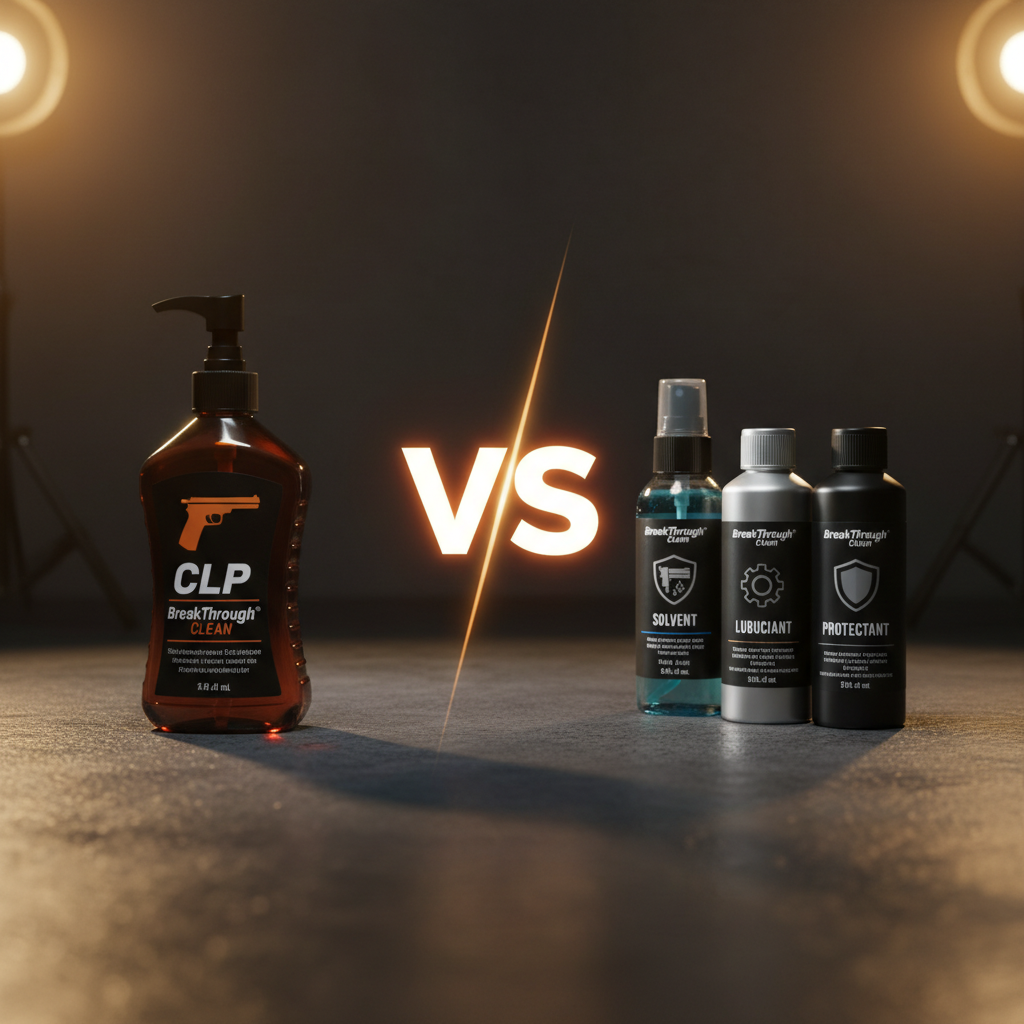
CLP vs Separate Products: Which Cleaning Approach Is Better?
A detailed comparison of all-in-one CLP versus dedicated solvents and lubricants. Learn when each approach makes sense and which products deliver the best results.
The debate between CLP (Clean, Lubricate, Protect) and separate dedicated products is one of the most common discussions among firearm owners. The honest answer? Both approaches work, but they excel in different situations. This comparison breaks down when each makes sense so you can make the right call for your cleaning routine.
Safety Notice
Always ensure your firearm is completely unloaded before cleaning. Remove the magazine, lock the action open, and visually and physically inspect the chamber. Perform all cleaning in a well-ventilated area.
Understanding the Two Approaches
The CLP Approach
CLP is a single product formulated to clean fouling, lubricate moving parts, and protect metal surfaces from corrosion. The concept originated with the U.S. military, which needed a simplified logistics chain—one product instead of three. Break-Free CLP is the benchmark product in this category and remains the standard military issue.
The advantage is simplicity. One bottle, one step, done. For routine maintenance after a casual range session, CLP handles the job efficiently and effectively.
The Separate Products Approach
Dedicated products are purpose-built to excel at one specific task. A dedicated solvent like Hoppe's No. 9 is formulated solely to dissolve carbon, copper, and lead fouling—and it does that job better than any multi-purpose product can. Pair it with a dedicated lubricant like Slip 2000 EWL, and you get optimized performance at every stage of the cleaning process.
The trade-off is more bottles, more steps, and more time. But for thorough cleaning, the results speak for themselves.
Head-to-Head Comparison
| Factor | CLP (Break-Free) | Separate (Hoppe's + Slip 2000) |
|---|---|---|
| Cleaning Power | Good for light fouling | Excellent—dedicated solvent excels |
| Lubrication Quality | Adequate for most uses | Superior—purpose-built lubricant |
| Corrosion Protection | Very good | Depends on lubricant choice |
| Convenience | One product, minimal steps | Multiple products, more steps |
| Speed | Fast—single application | Slower—clean then lube |
| Field Maintenance | Ideal—one bottle to carry | Less practical in the field |
| Heavy Fouling | Struggles with heavy carbon | Solvent dissolves heavy buildup |
| Cost | Lower—one product | Higher—two or more products |
| Best For | Casual shooters, maintenance | Serious shooters, deep cleaning |
Featured Products

Break-Free CLP
Best for: Convenience and field maintenance
The original Clean-Lubricate-Protect formula trusted by the U.S. military for decades. One product handles all three cleaning functions—solvent action to dissolve fouling, lubrication for moving parts, and a protective film against corrosion.
Pros
- + One product does everything
- + Military proven formula
- + Excellent corrosion protection
Cons
- - Mediocre at heavy carbon removal
- - Not the best standalone lubricant
- - Compromises vs dedicated products

Hoppe's No. 9 Solvent
Best for: Deep bore cleaning and fouling removal
The classic bore cleaning solvent that has been the industry standard since 1903. Dissolves copper, lead, and powder fouling with unmatched effectiveness. The distinctive smell is synonymous with gun cleaning for generations of shooters.
Pros
- + Superior fouling removal
- + Over 120 years of proven results
- + Effective on copper and lead
Cons
- - Strong chemical odor
- - Not a lubricant—you need oil too
- - Requires ventilation when using

Slip 2000 EWL
Best for: Long-lasting firearms lubrication
A synthetic, non-toxic extreme weapons lubricant designed specifically for firearms. Provides superior lubrication at temperature extremes and does not attract dust or grit the way petroleum-based oils can.
Pros
- + Non-toxic and odorless
- + Excellent at extreme temperatures
- + Does not attract dust
Cons
- - No cleaning ability
- - Premium price for lubricant
- - Must be paired with a solvent
When to Use CLP
CLP is the right choice when:
- Quick post-range cleaning: You fired a box or two and need basic maintenance
- Field maintenance: You're hunting, at a class, or away from your bench
- Light-duty firearms: A carry gun that sees occasional range time
- Simplicity matters: You want one product in your range bag
- Storage prep: A wipe-down before putting a firearm away
When to Use Separate Products
Dedicated solvents and lubricants make more sense when:
- Heavy shooting sessions: Hundreds of rounds of carbon buildup
- Competition firearms: Peak performance demands optimized lubrication
- Copper fouling: Rifle bores with copper jacket buildup need a real solvent
- Extreme conditions: Very hot, cold, or dusty environments
- Thorough deep cleaning: Periodic full disassembly and cleaning
The Best of Both Worlds
Many experienced shooters use CLP for routine wipe-downs and quick maintenance, then pull out the dedicated solvent and lubricant for periodic deep cleaning sessions. There is no rule saying you must pick only one approach.
Our Verdict
For most firearm owners, start with CLP. Break-Free CLP handles 80% of maintenance needs with minimal fuss. It's what the military uses, it works, and it simplifies your cleaning routine.
Add separate products when you need them. As your shooting volume increases or you encounter stubborn fouling that CLP can't quite handle, bring in a dedicated solvent like Hoppe's No. 9 for deep cleaning sessions. Pair it with Slip 2000 EWL for superior long-term lubrication.
The bottom line: CLP for convenience and light use, separate products for deep cleaning and demanding conditions. The best approach is the one that keeps you actually cleaning your firearms regularly.
Related Resources
- Oils & Solvents →
- Cleaning Explained →
- Best Budget Accessories Under $50 →
- Bore Snakes vs Cleaning Rods →
Looking for more options? Browse all oils, solvents & lubricants →
Affiliate Disclosure: FirearmCharm.com is a participant in the Amazon Services LLC Associates Program. We may earn a commission from qualifying purchases at no additional cost to you. Our recommendations are based on thorough research and are not influenced by commission rates.