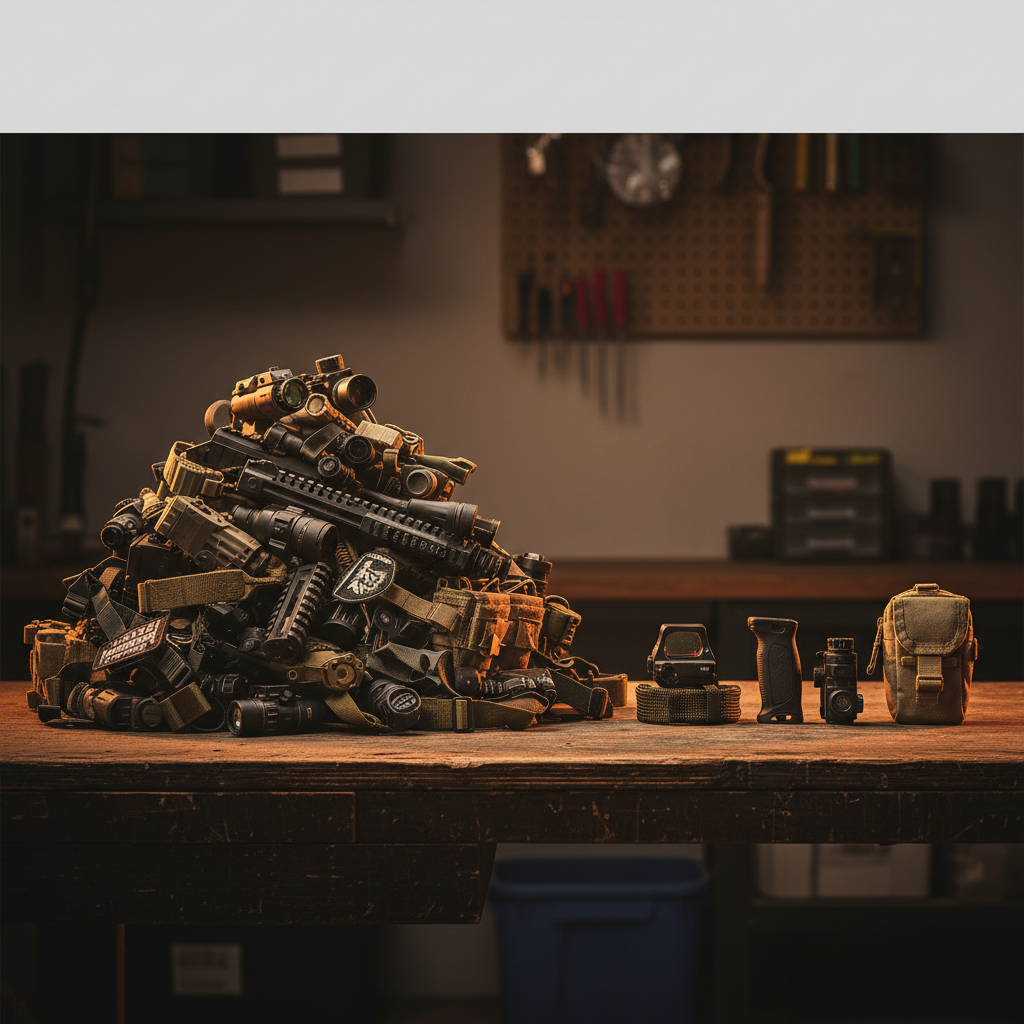
What You Don't Need
An honest guide to overhyped firearm accessories. Save money by skipping the gimmicks and investing in what actually matters.
The firearm accessory market is enormous—and a significant portion of it exists to sell solutions to problems you don't have. This guide isn't about gatekeeping or telling anyone how to spend their money. It's about honest perspective on what delivers real value versus what looks cool on a product page but gathers dust in a drawer.
The Golden Rule of Accessories
Before buying any accessory, ask: "Will this make me safer, more accurate, or more reliable?" If the honest answer is "no, but it looks cool," reconsider. That money might be better spent on range time, training, or quality storage.
Cheap Laser Sights
Budget laser sights are one of the most purchased—and most abandoned—firearm accessories. Here's why most shooters don't need them:
The Marketing Promise
Point the dot at the target, pull the trigger. Instant accuracy, right? Not quite.
The Reality
- Invisible in daylight: Cheap red lasers wash out in ambient light. You can barely see the dot at 10 yards in a well-lit indoor range, let alone outdoors.
- Battery dependency: The one time you actually need it, the battery will be dead if you haven't maintained it.
- False confidence: Relying on a laser instead of learning proper sight alignment creates a dependency on a device that can fail.
- Zero shifting: Budget lasers lose zero easily. A laser that doesn't point where the bullet goes is worse than no laser at all.
- Slow acquisition: Finding a small dot on a target is often slower than using iron sights, especially under stress.
The Exception
Quality laser/light combos from reputable manufacturers (Streamlight TLR series, Crimson Trace) can be genuinely useful for home defense handguns. The key word is quality—expect to spend $150+ for a laser that actually holds zero and is visible when it matters.
Unnecessary Rail Accessories
Modern handguards come with rows of M-LOK slots or Picatinny rail sections, and the temptation is to fill every one of them. Don't.
What You Probably Don't Need
- Rail covers for unused slots: M-LOK slots are designed to be left empty. They don't snag, and they don't need covers. If you want a smoother grip, a pair of rail panels where you grip is enough.
- Vertical foregrips (for most shooters): Unless you're shooting full-auto or doing frequent room-clearing drills, a vertical grip adds weight and bulk. Most shooters are better served by a simple handstop or C-clamp grip.
- Multiple accessory mounts: A light, a sling mount, and maybe a laser. That's all most rifles need on the handguard. If your rail looks like a Christmas tree, something has gone wrong.
- Bipod on a 16" carbine: Unless you're actually shooting at distances that benefit from a supported position, a bipod on a general-purpose carbine adds weight and gets in the way.
Weight Adds Up Fast
Every accessory adds weight. An AR-15 that started at 6.5 pounds can easily reach 9-10 pounds with accessories. That extra weight contributes to fatigue, slower transitions, and a rifle that's less enjoyable to shoot. Be ruthless about what earns a place on your firearm.
"Tactical" Gadgets
The word "tactical" on a product often means a 200% markup for a black finish and aggressive marketing. Here are common offenders:
Tactical Pens
A pen marketed as a defensive tool. In reality, it's a heavy, expensive pen. If you need a self-defense tool, invest in actual training. If you need a pen, buy a pen.
Phone-Mount Thermal/Night Vision
Budget thermal clips that attach to your phone and claim to provide night-vision capability. The resolution is usually poor, the refresh rate laggy, and mounting it to a firearm via your phone is neither practical nor safe. Quality thermal optics exist, but they start at $500+ for a reason.
Universal Magazine Loaders
Unless you have hand strength or dexterity issues—in which case, a quality loader like the Maglula UpLula is genuinely helpful—most shooters don't need a magazine loader. Loading magazines is a skill that gets easier with practice.
Tactical Flashlight Mounts for Shotguns
If you're using a shotgun for home defense, a dedicated weapon light (Streamlight, SureFire) is a solid investment. A $12 barrel-clamp flashlight mount holding a gas station flashlight is not. The mount will shift, the light will fail, and you've created an unreliable system for a critical situation.
Extended Controls for Casual Shooters
Extended magazine releases, oversized bolt catches, ambi-everything—these are genuine performance upgrades for competitive shooters and professionals who manipulate their firearm hundreds of times per session. For the average range shooter:
Extended Magazine Releases
- Stock magazine releases work fine with proper technique
- Extended releases can lead to accidental mag drops from bumping
- Practice the correct release motion instead of buying a bigger button
Oversized Charging Handles
- Useful if you shoot with optics that crowd the standard handle
- Useful for competition where speed matters at that level
- For range shooting? The stock handle works perfectly well
The Pattern
These accessories solve real problems—for people who actually have those problems. A competitive shooter who runs 500 rounds per match benefits from faster controls. A casual shooter putting 50 rounds through their rifle monthly doesn't need to shave fractions of a second off their reload.
The Honest Test
Before buying a performance accessory, ask yourself: "Am I limited by the equipment or by my skill?" In almost every case for non-competitive shooters, the answer is skill. That money is better spent on ammunition and range time.
Over-Engineered Cleaning Products
The cleaning product market has exploded with specialty products that promise revolutionary results. The truth is simpler.
What You Actually Need
- A quality bore solvent: Hoppe's No. 9 has been the standard for over a century because it works.
- A good CLP: Break-Free CLP handles light cleaning, lubrication, and protection in one bottle.
- Correct-sized brushes and patches: Matched to your caliber.
- That's it. For 90% of firearm owners, those three categories cover all your needs.
What You Can Skip
- "Nano-ceramic" bore treatments: Claims of permanent bore protection that eliminates the need for cleaning. If it sounds too good to be true, it is.
- $40 microfiber cleaning cloths: An old cotton t-shirt works just as well for wipe-downs.
- Ultrasonic cleaners (for most owners): Useful for gunsmiths processing many parts. Overkill for personal cleaning.
- Separate products for every step: Pre-cleaner, cleaner, post-cleaner, pre-lubricant, lubricant, protectant—no. A solvent and a CLP handle it.
Cosmetic "Upgrades"
There's nothing inherently wrong with customizing the appearance of your firearms. The problem arises when cosmetic spending competes with functional needs.
Common Money Pits
- Custom Cerakote before you have a safe: A $300 finish job on a firearm stored unsecured is backwards priorities.
- Decorative dust covers: "Come and take it" engravings and punisher skulls don't make your rifle more accurate.
- Color-matched accessories: Paying a premium for matching FDE or OD green when black functions identically.
- Aftermarket backplates and pins: Changing the slide cover plate on a Glock is the firearm equivalent of stick-on chrome vents on a Honda.
What to Spend Money On Instead
If you have budget to spend, here's where it delivers the most value:
High-Value Investments
| Investment | Why It Matters | Typical Cost |
|---|---|---|
| Training course | More improvement per dollar than any accessory | $100-300 |
| Ammunition for practice | Skill requires repetition | Ongoing |
| Quality safe | Security, protection, and responsibility | $150-1,500 |
| Quality ear protection | Hearing damage is permanent | $40-80 |
| Basic cleaning kit | Maintains reliability and value | $30-90 |
| Quality weapon light | Target identification is a safety requirement | $100-250 |
The "Wait 30 Days" Rule
Before purchasing any accessory over $50, wait 30 days. If you still want it—and can articulate a specific, functional reason—buy it. This simple rule eliminates impulse purchases driven by YouTube reviews, forum hype, and marketing.
During those 30 days:
- Research alternatives and read critical reviews (not just 5-star endorsements)
- Ask yourself if training or practice would solve the same problem
- Verify compatibility with your specific firearm
- Check whether the money would be better spent on a higher-priority need
Important Safety Warning
Never compromise on safety to fund accessories. If you don't have secure storage, quality ear and eye protection, and a basic cleaning kit, those come first. No optic, no laser, no tactical accessory is more important than safe and responsible ownership fundamentals.
The Bottom Line
The firearm industry is excellent at creating desire for products. Most of what's marketed as essential is optional, and much of what's marketed as game-changing is marginally useful at best. The best-equipped shooter isn't the one with the most accessories—it's the one who is well-trained, practices regularly, stores their firearms securely, and maintains them properly.
Function over flash. Training over trinkets. Safety over style.
Related Resources
Affiliate Disclosure: FirearmCharm.com is a participant in the Amazon Services LLC Associates Program. We may earn a commission from qualifying purchases at no additional cost to you. Our recommendations are based on thorough research and are not influenced by commission rates.