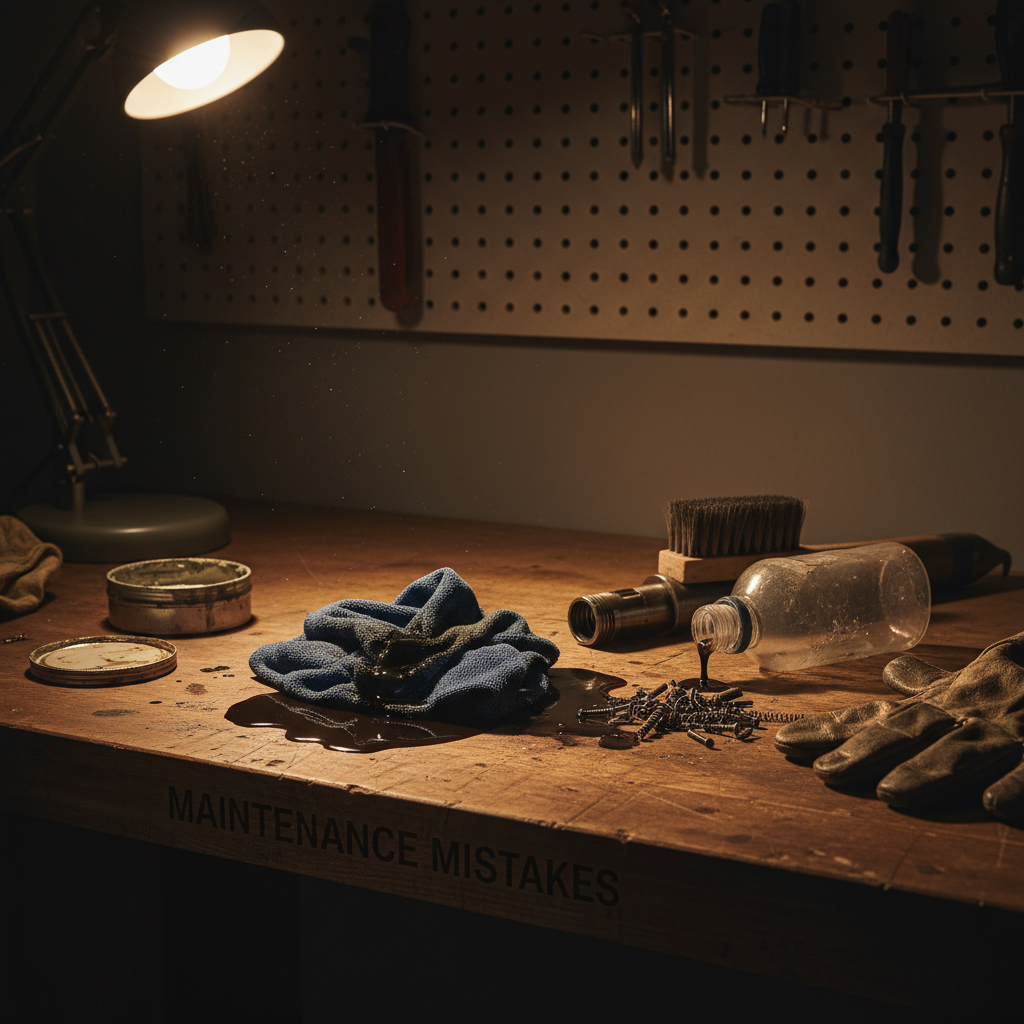
Common Mistakes to Avoid
The most frequent firearm maintenance and accessory mistakes that damage firearms, waste money, and compromise reliability. Learn what not to do.
Even experienced firearm owners develop bad habits or follow outdated advice. These common mistakes damage firearms, reduce reliability, waste money, and in some cases create safety hazards. This guide covers the errors we see most often—and how to avoid them.
Important Safety Warning
Every firearm maintenance procedure starts the same way: Remove the magazine, lock the action open, and visually and physically verify the chamber is empty. No exceptions, no shortcuts, every single time.
Mistake #1: Over-Oiling
This is the single most common maintenance mistake. The instinct is understandable—oil protects against rust, so more oil means more protection, right? Wrong.
Why Over-Oiling Is a Problem
- Attracts dirt and debris: Excess oil is a magnet for dust, powder residue, and grit. This creates an abrasive paste that accelerates wear.
- Gums up actions: Oil mixed with debris thickens into a varnish-like substance, especially in cold weather. This can slow or freeze the action.
- Penetrates unwanted areas: Excess oil seeps into the primer pockets of stored ammunition, can deaden primers, and soaks into wood stocks causing deterioration.
- Creates a false sense of security: A visibly oily firearm looks well-maintained but may actually be worse off than a properly lubricated one.
The Right Approach
Use the minimum amount of lubricant needed. After applying oil or CLP, wipe down surfaces with a clean, dry cloth. The goal is a thin protective film—not a visible wet coating. Specific lubrication points vary by platform, but the general rule is:
- A single drop on each slide rail or bearing surface
- A thin film on the bolt carrier and cam pin
- A light patch through the bore for storage protection
- Wipe, don't soak, exterior surfaces
The Paper Towel Test
After lubricating, wipe the firearm down with a paper towel. If the towel comes away soaked, you've used too much. A barely visible sheen on the towel is correct. You should be able to handle the firearm without your hands getting oily.
Mistake #2: Cleaning in the Wrong Direction
The direction you push a cleaning rod matters more than most people realize. The muzzle crown is the last surface a bullet contacts before leaving the barrel—damage to the crown directly impacts accuracy.
The Correct Method
- Always clean from breech to muzzle when the platform allows it (bolt-action, AR-15 with upper removed)
- Use a bore guide to center the rod and prevent solvent from entering the action
- Protect the muzzle crown: If you must clean from the muzzle (revolvers, some lever-actions), use a muzzle guard to prevent rod contact with the crown
- Never reverse a bore brush mid-stroke: Push it all the way through, then pull back. Reversing mid-bore can bend bristles and jam the brush.
Mistake #3: Ignoring Storage Climate
Many gun owners invest in a safe but ignore what's happening inside it. A sealed safe in a humid environment becomes a rust incubator.
The Problem
- Humidity above 50% accelerates corrosion on all metal surfaces
- Temperature swings cause condensation inside the safe—even if the room seems dry
- Closed safes trap moisture: Without air circulation, humidity builds from outgassing of foam liners and stored items
- Basements and garages are the worst offenders—high humidity, poor temperature regulation
The Fix
- Install a dehumidifier rod: GoldenRod-style heated rods circulate air and keep humidity low inside the safe
- Use desiccants: Rechargeable silica gel canisters as a supplement or for smaller storage
- Monitor humidity: A small digital hygrometer inside the safe tells you exactly what conditions your firearms face
- Avoid foam-lined soft cases for long-term storage: Foam traps moisture against the metal (see Mistake #7)
Mistake #4: Using Cheap Locks
Security is only as strong as the weakest link. A quality safe with a dollar-store padlock defeats the purpose.
What to Avoid
- Cheap padlocks: Can be picked in seconds with basic tools
- Cable locks as primary security: A cable lock prevents the action from cycling but doesn't prevent theft of the entire firearm
- Keyed-alike locks: Mass-produced locks where thousands share the same key
- Unanchored lock boxes: A small safe that isn't bolted down can simply be carried away
What to Use Instead
- Quality safes with UL-listed locks (electronic or mechanical)
- Safes bolted to the floor or wall structure
- Quality padlocks (Abus, American Lock, Master Lock Pro Series) for transport cases
- Cable locks as a supplement, not a replacement for secure storage
Lock Quality Matters
A firearm security device is only as effective as the lock that secures it. Invest in quality locks. The $5 saved on a cheap padlock is meaningless compared to the consequences of unauthorized access.
Mistake #5: Skipping Torque Specs on Optics
Mounting a scope by "feel" or "until snug" is a recipe for problems. Scope rings and mounts have specific torque requirements for good reasons.
Under-Torqued
- Scope shifts under recoil, losing zero
- Rings rotate on the base
- Scope creeps forward in the rings over time
- You end up constantly re-zeroing
Over-Torqued
- Crushes the scope tube, damaging the erector system
- Can crack ring caps on lower-quality rings
- Strips threads in aluminum receivers or mounts
- Damage may not be immediately apparent—scope may work initially then fail
The Solution
Use an inch-pound torque wrench. They're inexpensive—the Wheeler FAT Wrench costs less than a single scope re-zero session at the range. Typical values:
- Ring cap screws: 10-18 inch-pounds (follow manufacturer's specification)
- Base-to-receiver screws: 15-25 inch-pounds
- Tighten in a cross pattern: Alternate between screws to ensure even pressure
- Use thread locker: A drop of blue Loctite 242 on base screws prevents loosening from recoil
Mistake #6: Using Wrong Caliber Brushes
It might seem like a brush that's close enough will work. It won't—at least not well.
Too Small
- Doesn't contact the bore walls effectively
- Passes through without scrubbing fouling
- Wastes time and solvent
Too Large
- Requires excessive force to push through
- Can get stuck, especially when combined with heavy fouling
- Wears out faster due to excessive compression
- Can damage the crown if you're pushing hard from the muzzle end
Common Caliber Brush Sizes
| Brush Size | Calibers |
|---|---|
| .22 cal | .22 LR, .223 Rem/5.56 NATO |
| .27 cal | 6.5mm Creedmoor, 6.5 Grendel |
| .30 cal | .308 Win/7.62 NATO, .30-06, .300 BLK |
| .357 cal | .38 Special, .357 Magnum, 9mm |
| .40 cal | .40 S&W, 10mm Auto |
| .45 cal | .45 ACP, .45 Colt |
| 12 gauge | 12-gauge shotgun only |
| 20 gauge | 20-gauge shotgun only |
Get a Universal Kit
If you own multiple calibers, a universal cleaning kit with a range of brushes and jags saves money and ensures you always have the right size on hand. The Otis Elite kit covers virtually every common caliber.
Mistake #7: Storing in Soft Cases Long-Term
This mistake catches people off guard because soft cases feel protective. They are—for transport. For storage, they're destructive.
Why Soft Cases Cause Damage
- Foam traps moisture: The padding that protects against impacts also holds humidity against metal surfaces
- No air circulation: Zipped shut, a soft case creates a microclimate that encourages condensation
- Chemical interaction: Some foam materials outgas chemicals that accelerate corrosion
- Finish damage: Over months, trapped moisture and chemicals etch bluing and other finishes
What to Do Instead
- Store firearms in a safe or cabinet with active humidity control
- If a safe isn't available, use silicone-treated gun socks that wick moisture away
- Use soft cases only for transport—uncase firearms when you arrive home
- If you must use a case for temporary storage, leave it partially unzipped in a climate-controlled room
Mistake #8: Neglecting the Cleaning Mat
Cleaning firearms on a bare table or newspaper leads to several problems:
- Solvents stain and damage furniture
- Small pins, springs, and parts roll away and disappear
- Hard surfaces can scratch finishes
- No organized space for disassembled parts
A quality cleaning mat—like the Real Avid Smart Mat—provides a padded, solvent-resistant surface with printed diagrams and parts trays. It's an inexpensive upgrade that makes every cleaning session more organized and efficient.
Mistake #9: Mixing Up CLP and Dedicated Products
CLP (Clean, Lubricate, Protect) products are convenient all-in-one solutions, but they involve trade-offs:
- CLP advantages: Convenient, good for light cleaning and field maintenance, reduces the number of products you carry
- CLP limitations: A jack-of-all-trades cleans less effectively than dedicated solvent, lubricates less effectively than dedicated oil, and protects less than dedicated preservatives
When to Use What
- Quick field cleaning: CLP is ideal
- Range day maintenance: CLP works well
- Deep cleaning: Use dedicated bore solvent first, then lubricate and protect separately
- Long-term storage: Dedicated preservative oil provides superior protection
- Heavy copper fouling: CLP alone won't cut it—use a dedicated copper solvent
Quick Reference: Mistakes at a Glance
| Mistake | Consequence | Fix |
|---|---|---|
| Over-oiling | Attracts debris, gums action | Thin film only, wipe excess |
| Wrong cleaning direction | Crown damage, reduced accuracy | Breech-to-muzzle with bore guide |
| Ignoring humidity | Rust and corrosion | Dehumidifier rod + monitoring |
| Cheap locks | Ineffective security | Quality locks, bolted safes |
| No torque wrench | Loose or crushed optics | Inch-pound torque wrench |
| Wrong caliber brushes | Ineffective cleaning | Match brush to caliber exactly |
| Soft case storage | Trapped moisture, rust | Safe or silicone gun socks |
Related Resources
Affiliate Disclosure: FirearmCharm.com is a participant in the Amazon Services LLC Associates Program. We may earn a commission from qualifying purchases at no additional cost to you. Our recommendations are based on thorough research and are not influenced by commission rates.