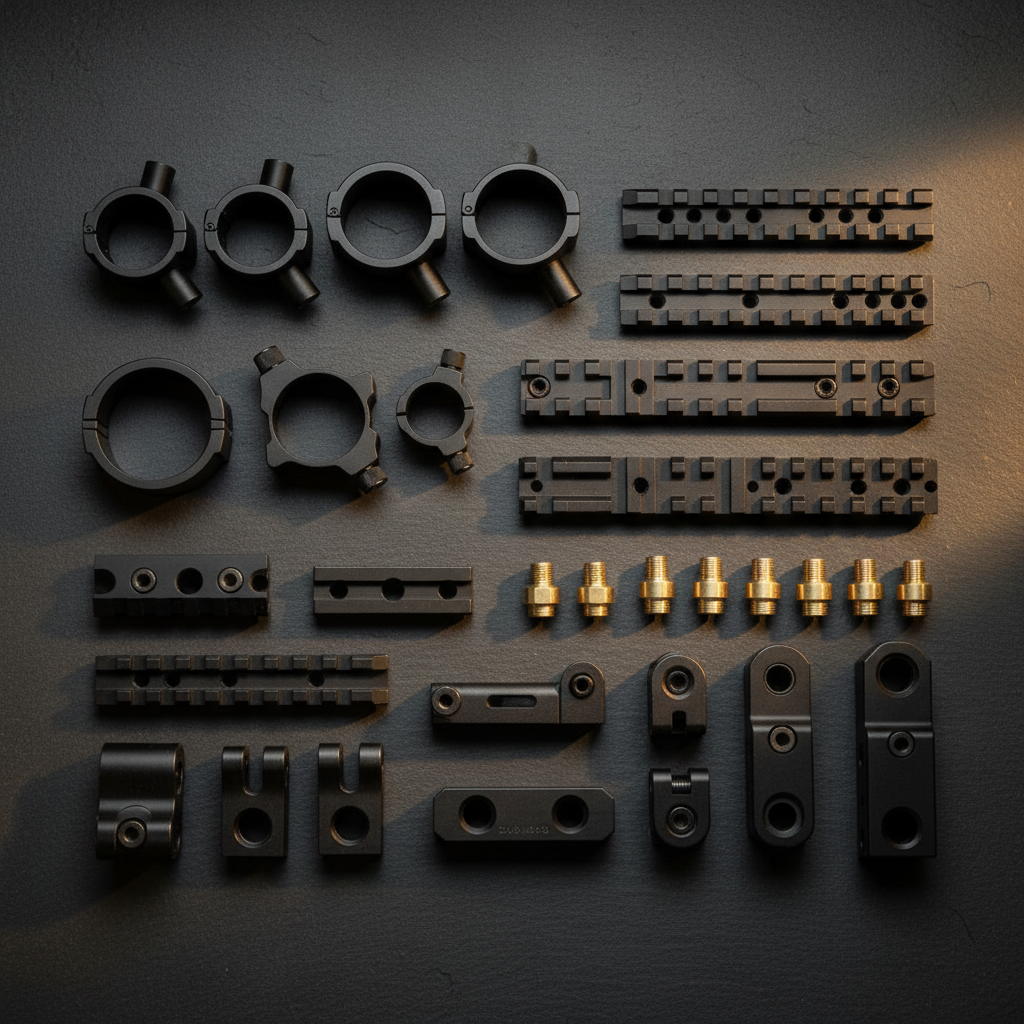
Accessory Compatibility Guide
Understand rail types, thread patterns, scope ring sizes, and mounting standards. Know what fits your firearm before you buy.
One of the most frustrating experiences for any firearm owner is ordering an accessory only to discover it doesn't fit. Rail systems, thread patterns, scope rings, and mounting standards can be confusing. This guide demystifies compatibility so you can buy with confidence and install with precision.
Safety Notice
Always verify your firearm is completely unloaded before installing, adjusting, or removing any accessory. Remove the magazine, lock the action open, and visually confirm an empty chamber. Improperly installed accessories can cause malfunctions, so follow manufacturer specifications exactly.
Rail Systems Explained
Rails are the universal mounting interface for firearm accessories—optics, lights, lasers, grips, and more. Understanding the differences between rail types is the foundation of accessory compatibility.
Picatinny Rail (MIL-STD-1913)
The Picatinny rail is the most widely used mounting standard in the firearms world. Developed at the Picatinny Arsenal in the 1990s, it became the NATO standard and remains dominant today.
- Slot spacing: 0.206" center-to-center
- Slot width: 0.206"
- Used for: Optics, lights, lasers, foregrips, bipods—virtually everything
- Found on: AR-15 upper receivers, bolt-action scope bases, handguards, shotgun receivers
- Compatibility: Accepts Weaver-style accessories (but not the reverse—see below)
Weaver Rail
The Weaver rail predates Picatinny and looks similar but is not identical. The key difference is slot spacing:
- Slot spacing: Varies (not standardized)
- Slot width: 0.180"
- Compatibility note: Weaver accessories fit Picatinny rails, but Picatinny accessories may not fit Weaver rails due to the wider recoil lug
Picatinny vs. Weaver Quick Rule
Weaver fits on Picatinny. Picatinny may not fit on Weaver. When in doubt, buy Picatinny-spec accessories—they're the most universal standard and will fit any Picatinny or full-size Weaver rail.
M-LOK
Developed by Magpul, M-LOK (Modular Lock) has become the dominant handguard mounting system for modern sporting rifles. Instead of a continuous rail, M-LOK uses slots in the handguard that accept T-nuts.
- Mounting method: T-nut slides into slot, tightens from accessory side
- Advantages: Lighter than full rail, slimmer profile, modular—add rail sections only where needed
- Used for: Handguards on AR-15s, AR-10s, and many modern rifles
- Accessory ecosystem: Extensive—grips, lights, rail sections, sling mounts, bipod adapters
- Picatinny adapters: Short rail sections can be attached to M-LOK slots to accept Picatinny accessories
KeyMod
KeyMod was developed by VLTOR and Noveske as an open-source alternative. It uses keyhole-shaped slots. While functional, it has been largely superseded by M-LOK:
- Current status: Still available but declining in new products
- U.S. military testing: SOCOM tested both and selected M-LOK in 2017
- Compatibility: KeyMod accessories only fit KeyMod handguards (not interchangeable with M-LOK)
- Recommendation: If purchasing a new handguard, choose M-LOK for the widest accessory selection
Proprietary Systems
Some manufacturers use proprietary mounting systems:
- HK proprietary rail: Found on some older HK handguards
- A2 handguards: Require adapter rails or replacement handguards for accessories
- Shotgun-specific: Many shotguns require brand-specific mounting solutions
Rail Comparison
| Feature | Picatinny | M-LOK | KeyMod | Weaver |
|---|---|---|---|---|
| Profile | Bulky | Slim | Slim | Bulky |
| Weight | Heavier | Lighter | Lighter | Heavier |
| Accessory Selection | Widest | Excellent | Declining | Good |
| Modularity | Low (full rail) | High | High | Low |
| Best For | Optics, top rails | Handguards | Legacy builds | Older platforms |
Thread Patterns for Muzzle Devices
Muzzle devices—flash hiders, muzzle brakes, compensators, and suppressors—thread onto the barrel. Using the wrong thread pattern means the device won't mount or, worse, could be dangerously cross-threaded.
Common Thread Patterns
| Thread Pattern | Common Calibers/Platforms |
|---|---|
| 1/2x28 TPI | 5.56 NATO/.223 Rem, 9mm, .22 LR—most common in the U.S. |
| 5/8x24 TPI | .308 Win/7.62 NATO, .300 BLK, 6.5 Creedmoor |
| M14x1 LH | AK-pattern rifles (7.62x39), left-hand thread |
| M24x1.5 RH | AK-pattern rifles (larger bore), some European imports |
| .578x28 TPI | .45 ACP pistols |
| M13.5x1 LH | 9mm European pistols (HK, SIG European models) |
Important Safety Warning
Never force a muzzle device onto a barrel. If it doesn't thread on smoothly by hand for the first several turns, stop immediately. Cross-threading can damage barrel threads and create a dangerous situation. Verify your thread pattern before purchasing any muzzle device.
How to Determine Your Thread Pattern
- Check your owner's manual: The manufacturer's documentation is the most reliable source.
- Measure the barrel: Use calipers to measure the outer diameter of the threaded portion and count threads per inch with a thread pitch gauge.
- Look up your model: Most popular firearm models have well-documented thread patterns.
- Ask a gunsmith: If you're unsure, a gunsmith can identify the pattern in seconds.
Scope Rings and Mounts
Mounting an optic properly is critical for accuracy and reliability. The wrong rings or mount can damage your scope, lose zero, or make proper eye relief impossible.
Scope Tube Diameter
Scope rings must match the tube diameter of your optic:
- 1 inch (25.4mm): Standard on many hunting scopes, budget optics
- 30mm: Most common for tactical and mid-to-high-end scopes
- 34mm: Found on high-end long-range and tactical scopes
- 35mm: Rare, used by some European manufacturers
Ring Height
Ring height determines how far above the bore the scope sits. Choose the lowest height that provides clearance:
- Low: Closest to bore, best for scopes with smaller objective lenses (up to ~36mm)
- Medium: Most versatile, works with 40-44mm objectives on most platforms
- High: Required for large objective lenses (50mm+) or raised receivers
- Extra high: Typically only for very large objectives or specific platform requirements
Choosing Ring Height
Measure from the top of your mounting base to the center of the bore, then compare against half the objective diameter plus a few millimeters for clearance. Many scope ring manufacturers provide compatibility charts for common rifle platforms—use them.
Mount Types
- Two-piece rings: Traditional, widely compatible, allow flexible spacing
- One-piece mounts: Better rigidity, maintain alignment between rings, popular for tactical use
- Quick-detach (QD): Lever-release mounts that allow rapid removal and return to zero
- Cantilever mounts: Extend the scope forward for proper eye relief on AR-platform rifles
Torque Specifications
Proper torque is essential. Under-torqued rings let the scope shift; over-torqued rings can crush the scope tube and damage internal adjustments.
| Component | Typical Torque | Notes |
|---|---|---|
| Ring base to receiver | 15-25 in-lbs | Follow mount manufacturer spec |
| Ring cap screws | 10-18 in-lbs | Tighten in alternating cross pattern |
| Windage/elevation screws | Varies | Consult scope manufacturer |
| Muzzle device | 15-30 ft-lbs | Use crush washer or shims as appropriate |
Platform-Specific vs. Universal Accessories
When to Buy Platform-Specific
Some accessories are designed for a specific firearm model and should be purchased accordingly:
- Holsters: Always buy model-specific for proper retention and draw
- Magazines: Always use the manufacturer-specified magazine for your firearm
- Stocks and grips: Must match receiver and action type
- Trigger assemblies: Must be designed for your exact platform
- Handguards: Must match barrel nut, gas system length, and receiver type
When Universal Works Fine
These accessories use standardized interfaces and are generally interchangeable:
- Picatinny-mount lights: Any light with a Pic mount fits any Pic rail
- M-LOK accessories: Standardized across manufacturers
- Sling swivels: QD sling swivels are universal
- Cleaning supplies: Caliber-matched, not platform-matched
- Optics: As long as tube diameter and rail type match
Compatibility Checklist
Before You Buy Any Accessory
- ☐ What rail system does your firearm use? (Picatinny, M-LOK, KeyMod, proprietary)
- ☐ What is your barrel thread pattern? (for muzzle devices)
- ☐ What is your scope tube diameter? (1", 30mm, 34mm)
- ☐ What ring height do you need? (based on objective lens size)
- ☐ Is this a platform-specific or universal accessory?
- ☐ Do you have the correct tools for installation? (torque wrench, proper bits)
- ☐ Have you read the manufacturer's installation instructions?
Essential Tools for Accessory Installation
Having the right tools prevents damage and ensures proper installation:
- Torque wrench (inch-pounds): Essential for scope mounting—the Wheeler FAT Wrench is the standard
- Gun vise: Holds the firearm securely during installation—the Tipton Best Gun Vise is a solid choice
- Bench mat: Protects surfaces and organizes parts—the Real Avid Smart Mat has a built-in parts tray
- Screwdriver set: Hollow-ground bits designed for firearm screws prevent cam-out and slot damage
- Thread locker: Blue Loctite (242) for most firearm screws—removable but prevents loosening from recoil
- Calipers: For measuring ring sizes, thread diameters, and clearances
Thread Locker Warning
Use blue (medium-strength) thread locker on accessory screws—never red (permanent). Red thread locker requires heat to remove and can damage firearm finishes. Apply sparingly: a tiny drop is sufficient. Too much can wick into areas where it doesn't belong.
Related Resources
Affiliate Disclosure: FirearmCharm.com is a participant in the Amazon Services LLC Associates Program. We may earn a commission from qualifying purchases at no additional cost to you. Our recommendations are based on thorough research and are not influenced by commission rates.